
Foundation & Post Systems in Post-Frame Construction
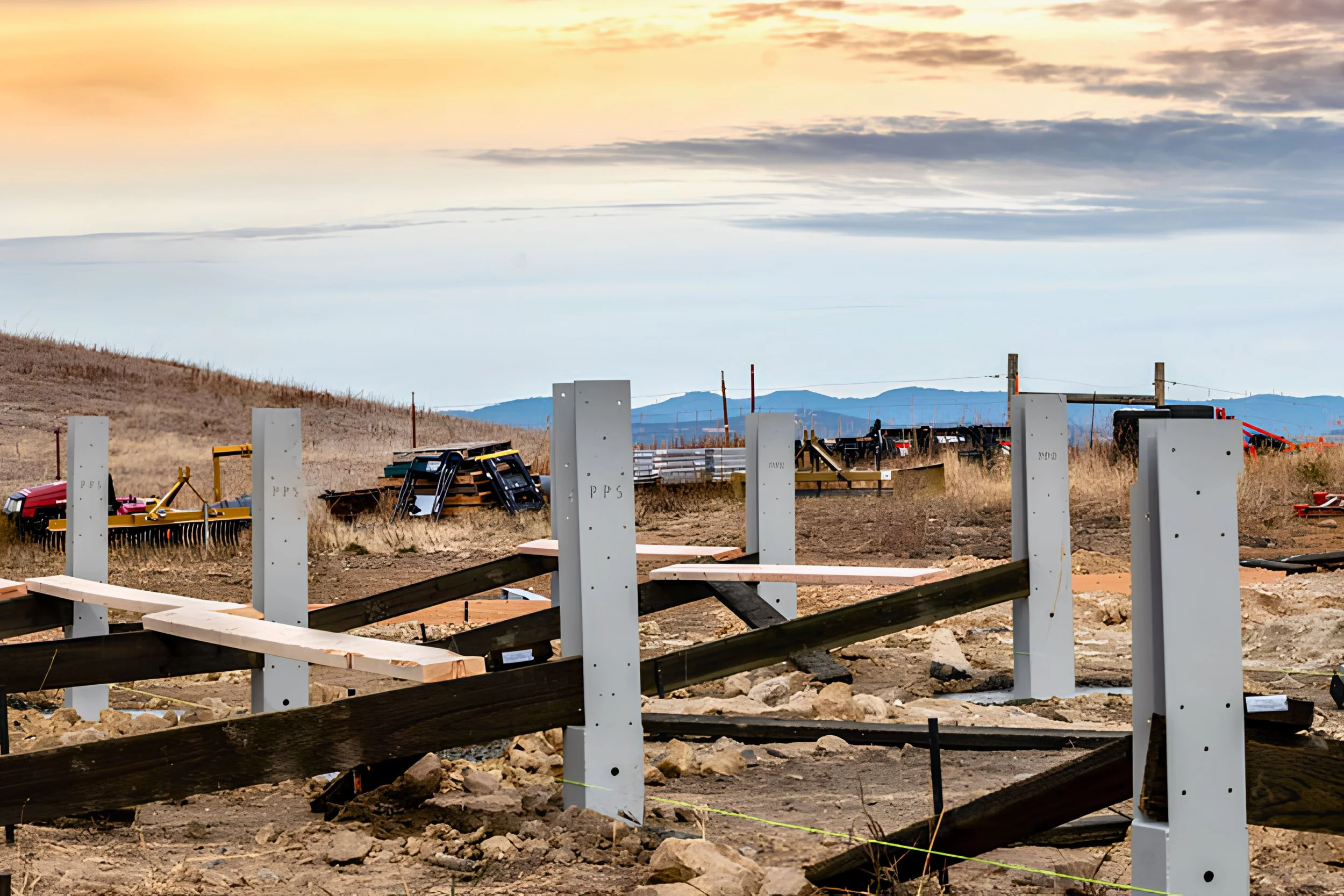
A Definitive Guide to Understanding the Structural Hierarchy From Basic Treated Wood Posts to Fully Engineered Permanent Foundations
The foundation and post system of a post-frame building is the single most important structural decision affecting longevity, performance, safety, and long-term cost. Whether the structure is a simple shop, an agricultural barn, a commercial facility, or a full residential barndominium, the building stands only as strong as the posts and foundation supporting it.
Over the past 40 years, post-frame foundations have evolved from basic chemically treated wood posts buried directly in the ground, to engineered laminated columns, to concrete-based hybrid systems, and now to advanced steel moment foundations such as the Permanent Post System (PPS). Each tier offers a different balance of durability, engineering reliability, cost, and long-term risk.
This article breaks down the hierarchy of foundation and post systems from the most basic to the most advanced, and explains why the future of post-frame construction is rooted in engineered, above-grade steel foundations.
1. BASIC — Solid-Sawn Treated Wood Posts (UC4B)
The Traditional System With No Warranty and Significant Long-Term Risk
For decades, the industry standard for pole barns was a single solid-sawn wood post set directly into the soil. This method relied almost entirely on chemical preservatives to slow decay.
Historical Practices
Pre-2000s pole barns almost universally used solid-sawn posts.
The Western United States commonly used Hem-Fir — often incised to help chemical absorption.
The Eastern U.S. relied heavily on Southern Yellow Pine, which absorbs preservatives more effectively.
CCA (Chromated Copper Arsenate) was still permitted in residential buildings, offering better decay resistance than today’s formulas.
The Modern Problem
Since 2003, CCA has been restricted for residential use, and alternative preservatives (ACQ, CA-C, MCQ) do not provide the same long-term decay resistance.
Additionally:
Heart-free posts are rare today, leading to more twisting, checking, and unpredictable performance.
Soil moisture, oxygen, and bacteria attack wood relentlessly.
The soil-line zone (2–4 inches below grade) remains the most common failure point in all buried wood posts.
Outcome
Buried solid-sawn posts may be inexpensive initially, but they are not permanent, are sensitive to soil conditions, and present a high likelihood of rot and future repair.
2. GOOD — Nail-Lam Columns (UC4B)
Stronger Than Solid-Sawn, Yet Variability and Lack of Regulation Create Limitations
Nail-lam columns combine multiple pieces of dimensional lumber fastened together with nails. Their purpose is to increase strength, stability, and straightness over a single solid-sawn member.
Advantages
More stable and straighter than solid posts.
Built from accessible materials.
Improved strength, especially for taller wall heights.
Customizable for load, height, and span requirements.
However, Serious Limitations Exist
Nail-lams are not manufactured in controlled environments.
Fasteners may not be designed for structural lamination.
Many do not meet AITC or AWC standards for engineered wood.
Jointing methods (butt joints, scarf joints) vary widely in quality.
Site-built nail-lams often carry no warranty and lack engineering oversight.
The Core Issue
Nail-lams mimic the concept of engineering without delivering true engineered reliability.
They are better than solid posts — but still vulnerable to rot when buried and inconsistent in structural performance.
3. BETTER — Glue-Lam Columns (Titan Timbers)
Engineered, Consistent, Structurally Superior — Ideal for High-Performance Buildings
Glue-lam (glulam) columns, such as Titan Timbers, are a major advancement in post-frame structure. These columns are engineered under strict manufacturing controls to produce superior strength and predictability.
Why Glue-Lams Are Superior
Manufactured in climate-controlled facilities.
Lumber is moisture-tested before lamination.
Structural adhesives bond the laminations under pressure.
Proper AITC-grade joint systems ensure safe load transfer.
Greater resistance to warping, twisting, and cracking.
Performance Advantages
Significantly higher strength-to-weight ratio.
Ideal for tall wall applications (16–24 feet).
Excellent for shops, garages, agricultural buildings, and barndominiums.
The Next Step Toward Permanence
Glue-lams solve the issues of instability and inconsistency — but when buried in soil, they remain vulnerable to the same moisture and decay conditions that affect all wood posts.
Engineered wood deserves an engineered foundation.
4. GREAT — Concrete-Based Precast Systems (Perma Columns)
An Improvement Over Buried Wood, With Structural and Practical Limitations
Perma Columns introduced the idea of separating wood from soil by using precast concrete posts with embedded steel hardware.
Strengths
Wood remains above grade.
The concrete base resists rot and decay.
Better longevity than any buried wood system.
Useful for agricultural and light-commercial buildings.
Limitations
Concrete can crack or break, especially at the rebar interface.
Concrete columns add significant weight, increasing freight and handling difficulty.
Size limitations exist — typically maxing out around 4-ply 2×8 configurations.
Many systems are not tested as full moment connections (column + hardware together).
Adjustability is limited; installation requires near-perfect alignment.
Concrete-based systems are a stepping stone toward permanence, but they are heavy, inflexible, and not engineered for advanced or large-scale post-frame structures.
5. BEST — Permanent Post System (PPS)
The Most Advanced, Fully Engineered, Above-Grade Post-Frame Foundation Available Today
The Permanent Post System represents the highest level of engineering, strength, adjustability, and long-term performance in post-frame construction.
Why PPS Leads the Industry
Steel strength ranging 36,000–64,000 PSI.
Fully engineered and tested as a complete moment connection at Washington State University.
Three-stage powder coating for corrosion resistance:
Sandblast
Prime
Powder coat
Fully adjustable to 1/32", ensuring perfectly straight walls.
70% lighter than concrete column systems, reducing freight and labor.
Able to produce any size bracket, including multi-ply 2×10 and 2×12 for large buildings.
Used successfully on 150-foot clear-span projects and multi-story structures.
Zero failures in more than a decade of field use.
Comes with a Lifetime Warranty.
The Clear Structural Advantage
PPS eliminates every weakness of buried wood and every limitation of precast concrete:
No rot
No soil contact
No chemical leaching
No cracking
No misalignment
No size restrictions
No load-transfer inconsistencies
It is the future of post-frame construction and the only foundation system capable of meeting the needs of high-performance barndominiums, commercial buildings, and extreme-span structures.
Conclusion
Foundation systems determine whether a building survives decades — or fails prematurely. The evolution from solid-sawn posts, to nail-lams, to glue-lams, to concrete systems, and finally to steel engineered foundations reflects the industry’s move toward permanence, reliability, and higher structural standards.
The message is clear:
Buried wood is temporary.
Concrete solutions are limited.
Engineered wood deserves engineered foundations.
Permanent Post System (PPS) is the only foundation built for true long-term structural performance.
When structure matters, choose the system that removes uncertainty and delivers permanence — today and for the life of the building.