
The Pitfalls of Burying Wood: Why It’s Not Suitable for Supporting Pole Barns
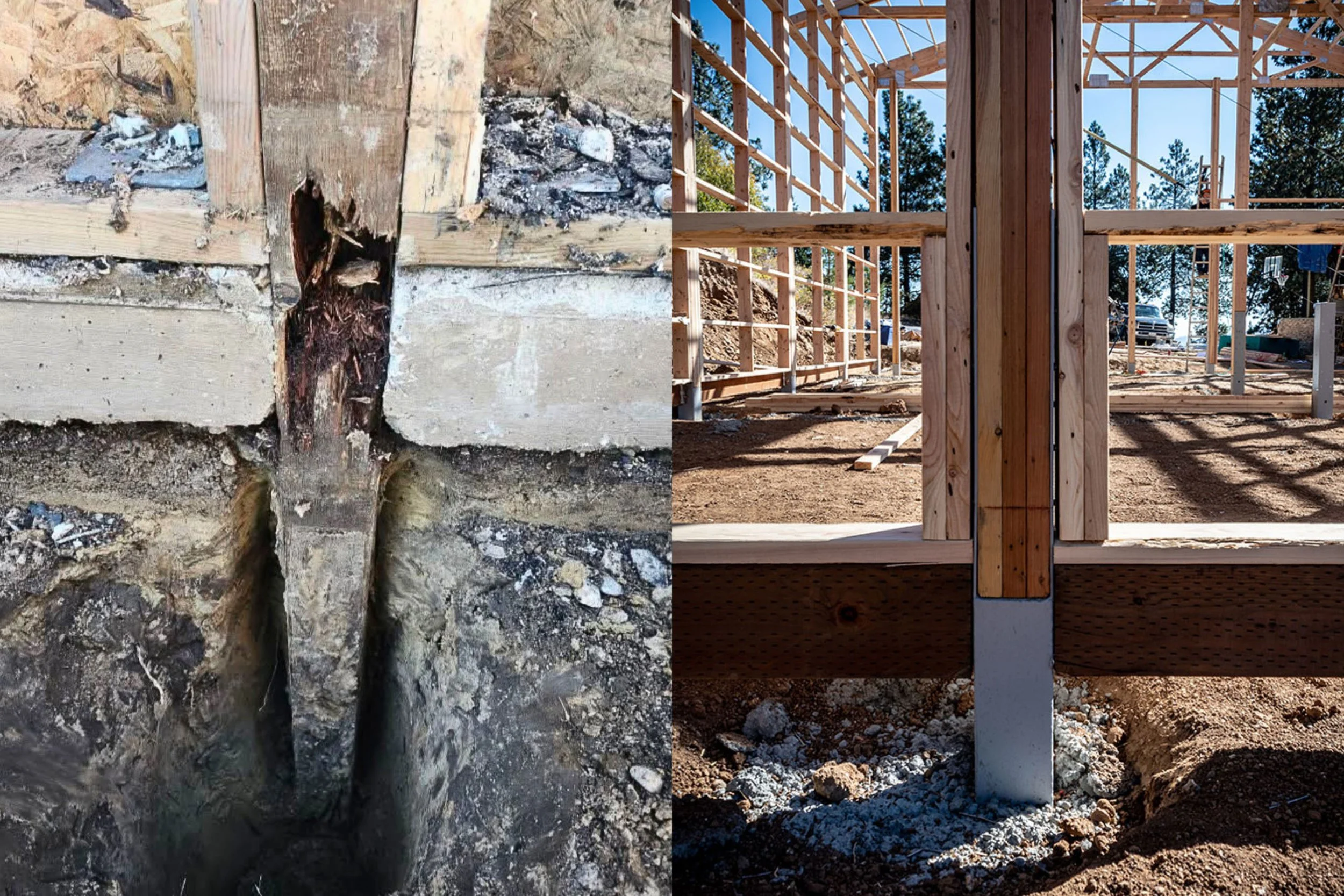
Why Modern Engineering, Soil Science, Code Requirements, and Real-World Failures Have Eliminated Buried Wood as a Permanent Foundation Option
For decades, burying treated wood posts in the ground was standard practice in post-frame construction. At the time, it was inexpensive, convenient, and widely accepted in agricultural settings. But as building science has advanced — and as thousands of premature failures have been documented across North America — one truth has become unavoidable:
Wood in the ground always rots. The only question is how long it will take.
Even with UC4B ground-contact treatment, even with incising, even with higher retention levels, buried wood cannot provide a permanent structural foundation. Today, homeowners, contractors, engineers, and building departments have moved toward permanent above-grade systems because the risks associated with buried posts are too significant to ignore.
This article explains, in clear and authoritative terms, why burying wood posts is no longer suitable for pole barns or barndominiums, and what modern alternatives provide long-term safety, strength, and compliance.
1. Moisture, Soil Chemistry, and Biological Decay — The Unavoidable Reality
Wood placed in the ground is exposed 24/7 to a destructive combination of:
Ground moisture
Fungal spores
Microbial activity
Soil acidity and pH variation
Bacteria that consume cellulose
Freeze–thaw cycles
Oxygen at the soil line (which accelerates fungal decay)
Even pressure-treated wood — including UC4B and older CCA posts — cannot stop the natural breakdown of organic material in a wet, oxygenated, microbe-rich environment.
What Happens Over Time
Even the best-treated posts will:
Absorb moisture
Swell and shrink
Crack and split
Leach preservative chemicals
Lose treatment retention in the soil-contact zone
Begin rotting internally or externally
Once preservatives leach, rot accelerates drastically.
This is why most failures occur between 2" above grade and 8" below grade — the exact zone where moisture, oxygen, and soil organisms work together to break down wood faster than any treatment can compensate.
2. Structural Integrity Declines Long Before Failure Becomes Visible
Pole barns rely on their columns to:
Resist uplift forces
Resist lateral movement
Hold roof loads
Transfer structural weight to the foundation
Maintain the building’s alignment and geometry
Once rot begins, structural performance collapses quietly.
You may not see failure until it’s too late
Buried posts often experience:
Rot hidden underground
Loss of bending strength
Weakening at the critical soil line
Reduced connection integrity
Increased risk during wind events
A building may still be upright — but it is no longer performing as engineered.
Every year, contractors across the U.S. are called to repair or completely rebuild structures because buried posts failed long before reaching their expected lifespan.
3. Code Compliance Challenges Are Increasing Nationwide
Modern structural codes and engineering standards have tightened significantly.
Many jurisdictions now:
Discourage
Restrict
Or outright prohibit
the use of in-ground wood posts for structural support in residential or commercial applications.
Reasons Building Departments Object
Long-term decay risk
Unpredictable soil conditions
Inconsistent treatment penetration
Questionable load resistance at end-of-life
Poor uplift and lateral performance
Lack of a true moment connection
Failed inspections, denied permits, and insurance complications are common outcomes when buried posts are used in the wrong application — especially for barndominiums.
4. Modern Alternatives Provide Permanent, Engineered Solutions
Today’s post-frame buildings benefit from far superior foundation systems that eliminate every weakness of buried wood.
Concrete Footings
Posts sit above grade on engineered brackets anchored to below-frost footings.
Concrete Piers
Reinforced piers are poured at each column location, creating a permanent base for above-grade posts.
Steel Anchors and Brackets
Engineered brackets provide structural uplift, lateral resistance, and long-term durability.
Permanent Post Systems (PPS)
Industry-leading above-grade steel foundation system engineered for:
True moment connections
Permanent post alignment
Full above-ground post protection
High wind and uplift resistance
Lifetime durability
PPS is powder-coated, WSU-tested, lighter than concrete systems, and backed by a Lifetime Warranty — making it the most advanced foundation option available for modern post-frame construction.
These systems eliminate rot completely while delivering superior structural integrity and predictable engineering performance.
5. Long-Term Costs Reveal the True Price of Buried Wood
Buried posts appear inexpensive up front — but long-term cost tells a different story.
Hidden Costs of In-Ground Wood
Premature rot
Post replacement
Jacking and re-supporting buildings
Realignment of trusses and sidewalls
Structural repair costs
Decreased resale value
Insurance disputes
Potential safety risks
A foundation system should last the lifetime of the building.
Buried wood does not.
Builders with experience know the pattern:
If you bury wood in the ground, you will eventually have to repair or replace it.
Conclusion: Modern Post-Frame Structures Deserve Permanent Foundations
Burying wood posts was an acceptable practice 30–40 years ago — today, it is outdated. Modern building science, real-world field data, environmental regulations, and engineering standards all point in the same direction:
Buried wood is not a permanent foundation system.
Permanent above-grade anchoring systems such as Permanent Post Systems, engineered concrete piers, and structural steel brackets provide:
Decades of durability
Full code compliance
Better engineering reliability
No rot, no decay, no chemical leaching
Lower long-term cost
Stronger uplift and lateral performance
Predictable, permanent structural behavior
Choosing the right foundation protects your building, your investment, and your peace of mind.
Your pole barn or barndominium will last for generations — but only when supported by a foundation system designed to last.